A ram marking harness holds a wax crayon against the ram’s brisket, so every ewe he mounts gets a coloured mark on her rump. Change the crayon colour on a fixed schedule, usually every 14 to 17 days, working from light to dark. The marks then tell you which ewes were served, roughly when, and which ones came back into heat.
Those dates are the most accurate way to predict lambing without a scanner. Each recorded mark date can go straight into a gestation calculator to give an expected lambing date and window.
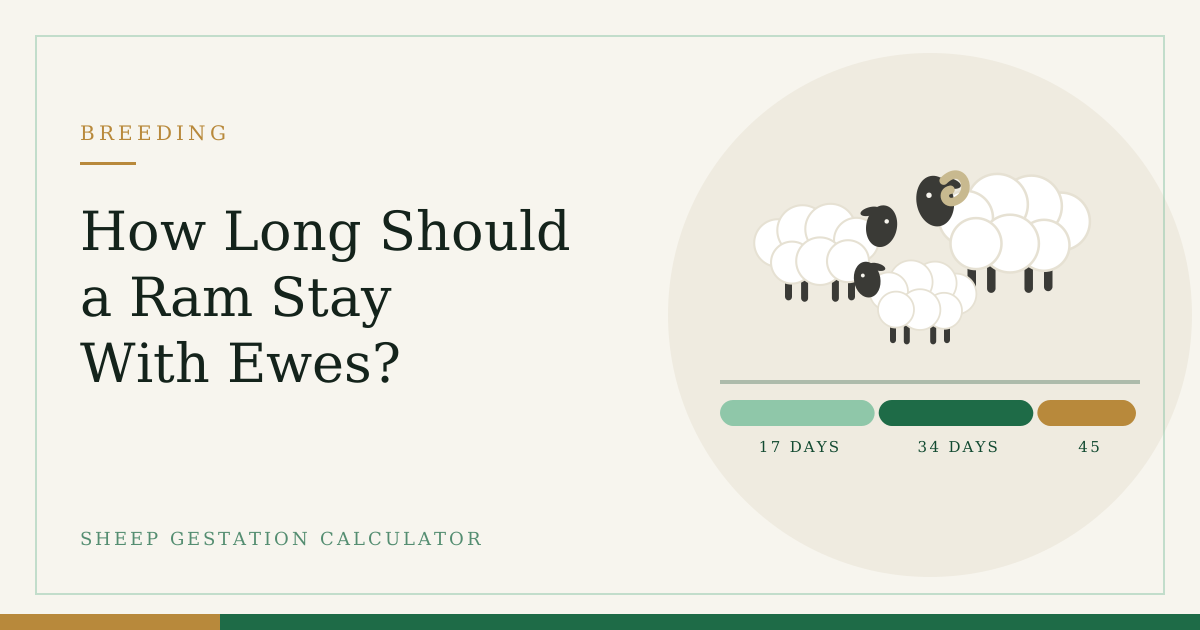
This guide covers fitting, crayons, colour schedules, recording and reading marks. How long the ram should stay in is covered separately in how long a ram should stay with ewes.
What a marking harness tells you, and what it does not
The Merck Veterinary Manual describes marking harnesses as useful for determining breeding dates, identifying the sire when more than one ram is used, and spotting ewes that are not settling.
In practice, a harness gives you:
- An approximate service date for each marked ewe.
- Lambing groups. Ewes marked in the same colour period will lamb around the same time.
- Returns to heat. A ewe marked again one cycle later probably did not conceive the first time.
- An early warning about the ram. Lots of re-marks, or very few marks, point to a problem while you can still act.
- Sire identity in multi-ram flocks, if each ram carries a different colour.
What it does not give you:
- Proof of pregnancy. A mark means the ram mounted her. It does not confirm a fertile service or a continuing pregnancy. Scanning does that.
- An exact service day, unless you check marks every day.
- A guarantee every service is marked. Faint crayons, heavy fleece and brief mounts can all miss.
In one Canadian flock’s records reported by Sheep Canada, marks identified the mating that led to pregnancy about 90% of the time, and about one ewe in 20 to 30 did not get marked. That is one flock, not a universal figure, but it is a realistic picture of how good the system is.
Harness, raddle paste or keel paint?
| Method | How it works | Pros | Cons |
|---|---|---|---|
| Harness and crayon | Straps hold a crayon block on the brisket | Clean, long-lasting, easy colour changes | Needs fitting and checking; can rub if badly fitted |
| Raddle paste | Pigment mixed with oil, smeared on the brisket | Cheap, no straps | Messy, wears off, needs frequent reapplying |
| Keel or marking paint | Ready-made paint applied to the brisket | No harness sores | Reapplication needed; can be less consistent |
Teagasc notes that crayon types are less messy and longer-lasting than raddle paste or paints. FAS Scotland points out that keel paint is an alternative where harness sores are a concern. Whichever you choose, use products designed for livestock marking.
Fitting the harness
Fit the harness following the manufacturer’s instructions for that model. The principles are the same for most designs:
- Position the crayon on the brisket, between the front legs, so it presses on the ewe’s rump when the ram mounts.
- Adjust it snug. It should be firm enough that the crayon stays in place and marks clearly, without restricting the ram’s movement or breathing.
- Check for rubbing points behind the front legs and over the shoulders.
- Let the ram settle. Many producers fit the harness a few days before joining so the ram gets used to it and they can check the fit.
Checking the harness during joining
FAS Scotland warns that ill-fitted harnesses can cause slow-to-heal brisket sores. Check rams at least every couple of days:
- Sores or hair loss under the straps. Loosen, pad or change to paint if needed.
- Fit as the ram loses condition. Teagasc reports rams can lose 15 to 20% of body weight over a five to six-week mating period, so a harness that was snug on day one can be loose by week three.
- Crayon wear. Replace crayons before they run out. An empty crayon holder looks like a ram that has stopped working.
- A slipped harness. A crayon that has slid to the side marks poorly or not at all.
Remove harnesses when rams come out, and check the skin underneath.
Choosing the right crayon grade
Marking crayons come in hardness grades for different temperatures. A crayon that is too hard for the weather leaves faint marks. One that is too soft wears away fast and smears.
As one example, the manufacturer Rurtec grades its Matingmark crayons as:
| Grade | Intended conditions (manufacturer guidance) |
|---|---|
| Cold | Cooler climates, generally below about 20°C (68°F) |
| Mild | Mild conditions between the two |
| Hot | Hot conditions, generally above about 30°C (86°F) |
Other brands use different names and temperature bands, and retailers do not always agree on the ranges for the same product. Follow the label for the crayon you buy. If marks are faint, try a softer grade. If crayons are disappearing in a day, try a harder one. Weather changes over a long joining, so a change of grade mid-season is sometimes needed.
Crayon colours: why light to dark
Always work from lighter to darker colours. A darker colour shows clearly over a lighter one, so a ewe marked twice carries visible evidence of both services. A light colour over a dark mark can be impossible to see.
Sequences recommended by different sources:
- Teagasc (Ireland): yellow, orange, green, red, blue, black.
- Ohio State University and Perennia (Canada): start with the lightest colour and move darker.
- FAS Scotland: start with a lighter colour such as yellow, then change to red.
Oklahoma State University suggests blue, red and green. That sequence works, but it does not follow the light-to-dark principle, so re-marks are harder to read. Most flocks are better served by yellow first and the darkest colour last.
Wool flocks: crayon and raddle can stain fleece. The American Sheep Industry Association recommends scourable, lanolin-based marking products where possible. Check with your wool buyer before joining if fleece value matters.
When to change colours
Published intervals vary, and the difference is not an error. It reflects what each flock wants the marks to show.
| Change interval | Sources | Best for |
|---|---|---|
| Every 7 to 10 days | FAS Scotland technical note; Beef + Lamb New Zealand | Creating tight lambing batches for housing and feeding groups |
| Every 14 days (or more often) | Teagasc; Perennia (14 to 16 days) | Detecting returns without missing short cycles |
| Every 15 to 17 days | Oklahoma State (15 to 17); Ohio State (16) | One colour per heat cycle, simple return detection |
Why many flocks change at 14 to 16 days rather than 17: the ewe cycle averages 16 to 17 days but ranges from about 14 to 19 days. If you leave one colour on for a full 17 days, a ewe marked early in the period with a short cycle can return and be re-marked in the same colour. That return is invisible. Changing a little earlier than the average cycle length reduces that risk.
For the biology behind these cycle lengths, see the ewe heat cycle guide.
A typical schedule for a 35-day joining
| Crayon colour | Days of joining | What a mark in this colour means |
|---|---|---|
| Yellow | Day 0 to 15 | First service for ewes cycling at ram introduction |
| Green | Day 16 to 31 | Either a first service for a late-cycling ewe, or a return from a yellow service |
| Red | Day 32 to ram removal | Late first service, or a second return; worth watching closely |
Recording marks
Marks are only useful if you record them. A notebook, a spreadsheet or a flock app all work.
How often to check:
- Daily checks give the most accurate service dates.
- Checks every 2 to 3 days are a practical compromise for most flocks. Record the date you first see the mark and note that the service happened since the previous check.
- Checks only at colour changes give you colour periods, not dates. That is still useful for lambing groups, but less precise for individual due dates.
What to record:
- Ewe ID.
- Date the mark was first seen and its colour.
- Ram ID or group, if more than one ram.
- Any re-mark, with date and colour.
- Notes such as faint marks, a lame ram, or crayon changes.
Spray-marking a number on each ewe or reading her ear tag at the same time makes records far faster at lambing.
Reading marks and re-marks
| Mark pattern at the end of joining | What it may mean | Suggested action |
|---|---|---|
| First colour only | Served at the start of joining and probably conceived | First lambing group |
| First colour, then second colour about 14 to 17 days later | Returned to heat; the first service probably failed | Plan from the second mark date |
| Second colour only | Was not cycling, ovulated silently, or cycled late | Second lambing group |
| Three colours | Repeated returns | Scan; check this ewe and the ram |
| No marks at all | Not cycling, already pregnant, or marks missed | Scan; review ewe condition and health |
| Mark pattern at an odd interval, such as 5 to 8 days apart | False mark, irregular cycle, or early embryo loss | Plan from the latest mark, confirm by scanning |
| Many ewes re-marked | Possible ram fertility problem | Act immediately, see below |
When re-marks point to the ram
Some returns are normal. A lot of returns are usually a ram problem:
- Teagasc advises concern if more than about 20% of ewes are marked a second time.
- Perennia suggests questioning the ram if more than about 25 to 30% return to service.
If you see this, change the ram or add another ram straight away and ask your veterinarian to examine the original ram. Waiting until scanning costs a full cycle or more. Also check whether the re-marked ewes all ran with the same ram, which narrows the problem down.
Marks are not proof
Ontario sheep-industry guidance notes that rams sometimes mount without serving, and that aggressive rams may mark ewes that are already pregnant. Treat marks as strong evidence, then confirm with pregnancy scanning.
Turning mark dates into lambing dates
Gestation averages about 147 days, with most ewes lambing between 142 and 152 days after service. That gives you:
- Expected lambing date = mark date + about 147 days.
- Earliest likely = mark date + about 142 days.
- Latest likely = mark date + about 152 days.
Always use the most recent mark for ewes marked more than once.
Example flock record
Rams went in on 1 November, with colours changed on 17 November and 3 December, and rams removed on 6 December.
| Ewe | Marks recorded | Date used | Expected lambing (147 days) | Normal window (142 to 152 days) | Note |
|---|---|---|---|---|---|
| 101 | Yellow, 5 Nov | 5 Nov | 1 Apr | 27 Mar to 6 Apr | First group |
| 102 | Yellow 3 Nov, green 19 Nov | 19 Nov | 15 Apr | 10 Apr to 20 Apr | Returned once |
| 103 | Green, 24 Nov | 24 Nov | 20 Apr | 15 Apr to 25 Apr | Late first service |
| 104 | Yellow, green and red | Latest red mark | Depends on date | Depends on date | Scan; investigate |
| 105 | No marks | None | Unknown | Unknown | Scan |
If a ewe was only checked at colour changes, use the first day of her colour period to find her earliest possible lambing date, and the last day of the period for her latest.
The quickest way to do this for every ewe is to enter each mark date in the Sheep Gestation Calculator. If you know the service or marking date, the calculator shows the expected lambing date and the normal lambing window. You can also choose your breed or set your flock’s own gestation length.
Using marks to plan the rest of the year
Once marks are recorded, they drive most of the pregnancy calendar:
- Scanning. Book the scanner for a date that suits the spread of marks. Our scanning guide covers timing.
- Feeding groups. Early-marked ewes need their late-pregnancy feed increase first.
- Vaccination timing. Pre-lambing boosters can be timed to each lambing group.
- Lambing supervision. Staff the shed for the busiest colour group and the start of each window.
Troubleshooting
| Problem | Likely causes | What to check |
|---|---|---|
| Almost no marks in the first week | Ewes not yet cycling, silent ovulations, ram not working, crayon too hard | Season timing, ram libido and soundness, crayon grade |
| Faint marks | Crayon too hard for the temperature, heavy fleece, loose harness | Switch to a softer grade, adjust fit |
| Crayons wearing out in a day or two | Crayon too soft, hot weather | Harder grade |
| Marks smeared over the whole flock | Loose harness, ewes crowding the ram at feeding | Tighten fit, observe behaviour |
| Ram has sores | Harness too tight or rubbing | Loosen, pad, or switch to paint |
| High re-mark rate | Ram fertility problem, disease, heat stress | Change ram, involve your veterinarian |
Frequently asked questions
How tight should a ram marking harness be?
Snug enough that the crayon stays centred on the brisket and marks clearly, but not so tight that it restricts movement or rubs. Follow the manufacturer’s fitting instructions and recheck every couple of days, because rams lose condition during joining and the harness loosens.
Does a raddle mark mean the ewe is pregnant?
No. A mark shows that the ram mounted her. It is a good indicator of service, and a ewe that is not re-marked one cycle later has probably conceived, but only scanning confirms pregnancy.
My ewe has two colours. Is my ram infertile?
Not necessarily. Some ewes return to heat even with a fertile ram. The concern is when a large share of the flock is re-marked, commonly more than about 20 to 30%. If that happens, change or add rams and have the original ram checked.
Which crayon should I use in hot weather?
Use a hard or “hot” grade crayon in hot weather and a soft or “cold” grade in cool weather. Temperature bands differ between brands, so follow the label.
How often should I change the crayon colour?
Most flocks change every 14 to 17 days to match the heat cycle and detect returns. Some change every 7 to 10 days to create tighter lambing groups. Changing slightly before 17 days reduces the chance of a short-cycling ewe returning in the same colour.
Sources and further reading
- Merck Veterinary Manual: Breeding and parturition in sheep
- Teagasc: Ram management during the mating season; Mating management and ram fertility
- FAS Scotland: Technical note TN767 and ram and raddle guidance
- Beef + Lamb New Zealand: Ram harnesses a valuable farm management tool
- Oklahoma State University Extension: Sheep reproduction fact sheet ANSI-3860
- Ohio State University Sheep Team: Reproductive management of the ewe flock and the ram
- Perennia (Nova Scotia): Tips for the sheep breeding season
- Rurtec: Matingmark crayon grades (manufacturer guidance)
- American Sheep Industry Association: Wool contamination guidance
- Sheep Canada: What a marking harness can tell you
This article is general husbandry guidance, not veterinary advice. If many ewes are returning to service, contact your veterinarian promptly.
Plan your lambing dates: use the free Sheep Gestation Calculator to turn a breeding date into an expected lambing date, a 142–152 day window and a full milestone timeline. Estimates only, always consult a veterinarian for animal-health decisions.