During the breeding season, a ewe that is not pregnant comes into heat roughly every 16 to 17 days, with a normal range of about 14 to 19 days. Each heat (estrus) usually lasts around 30 hours, although anything from about 20 to 42 hours is within normal limits. She ovulates late in heat, roughly a day after it begins.
Most ewes show very little visible heat behaviour unless a ram is present. That is why most flocks rely on rams, teasers and marking crayons rather than watching.
This guide covers the individual ewe’s cycle. For the time of year when ewes cycle at all, see the sheep breeding season guide.
Ewe heat cycle at a glance
| Measure | Typical value | Normal range and notes |
|---|---|---|
| Cycle length (heat to heat) | 16 to 17 days | About 14 to 19 days |
| Heat (estrus) duration | About 30 hours | About 20 to 42 hours; shorter in ewe lambs and at the start and end of the season |
| Standing heat | About 10 to 12 hours | The part of heat when she stands firmly for mounting |
| Ovulation | Late in heat | Roughly 24 hours after heat begins; sources range from 12 to 36 hours after onset |
| Egg lifespan after ovulation | About 10 to 25 hours | Why sperm needs to be waiting when she ovulates |
| Eggs released per heat | Often 1 to 3 | Breed, age and body condition drive this |
| Return to heat if not pregnant | 16 to 17 days after the last heat | Main sign that a service failed |
These figures come from the Merck Veterinary Manual, University of Kentucky and New Mexico State University extension, the Canadian Sheep Federation and Ontario sheep-industry guidance. They are averages. Breed, age, season and nutrition all shift individual ewes.
How often do ewes come into heat?
A cycling ewe returns to heat every 16 to 17 days on average. New Mexico State University gives 17 days with a range of 14 to 19. Queensland government material quotes about 16 days. Across sources, 16 to 17 days is a sound planning figure.
That regularity only applies during the breeding season. Sheep are seasonal breeders, so most ewes stop cycling during seasonal anestrus in late winter, spring and early summer. A ewe that “misses” heats in May in the Northern Hemisphere is usually not faulty. She is simply out of season.
She also stops cycling when she becomes pregnant, which is the whole basis of checking for returns to heat.
How long is a ewe in heat?
Most mature ewes stay in heat for about a day and a half:
- Merck Veterinary Manual and Canadian Sheep Federation: about 30 hours.
- University of Kentucky and New Mexico State University: 20 to 42 hours, averaging 30 to 35.
- Ontario sheep guidance: 24 to 36 hours, of which true standing heat is about 10 to 12 hours.
Heat length changes with:
- Age. Ewe lambs and maiden ewes have shorter, less intense heats, and they are less likely to seek out the ram.
- Stage of the season. Heats are shorter at the start and end of the breeding season and longer and stronger in mid-autumn.
- Ram presence. Contact with a ram strengthens and can shorten heat.
- Breed. Some breeds show much more obvious heat than others.
- Heat stress. The Canadian Sheep Federation notes that hot, humid weather can reduce heat behaviour even when ewes are still cycling.
If you see very short heat periods quoted online, such as under an hour, they usually describe the brief time a shy ewe was actually seen standing, not the full estrus.
When does a ewe ovulate?
Ovulation happens towards the end of heat:
- Merck: 12 to 36 hours after the start of estrus.
- University of Kentucky: during the last 6 to 10 hours of estrus.
- Ontario: near the end of heat, about 24 hours after onset.
These figures agree once you remember that heat itself lasts about 30 hours. Put simply, the ewe ovulates roughly a day after she first comes into heat.
Timing matters most for artificial insemination and hand-mating, where the ewe is served once:
- Canadian Sheep Federation guidance puts the best single mating at about 9 to 12 hours after heat starts.
- Ohio State University material suggests 12 to 18 hours, in the first half of heat.
With natural service in a paddock, the ram usually serves a ewe several times during her heat, so exact timing takes care of itself.
How many eggs does she release?
Ontario sheep guidance puts the average for most breeds at about 1.5 eggs per heat, with prolific breeds such as Finnsheep averaging about 3. Ovulation rate usually peaks between about three and six years of age and rises with better body condition. A higher ovulation rate is why flushing ewes before breeding can increase twinning in the right ewes.
The stages of the ewe’s cycle
You do not need hormone detail to manage a flock. A basic picture does explain why returns come at 16 to 17 days.
- Follicular phase (a few days). Follicles grow on the ovary and produce estrogen. Rising estrogen brings on heat behaviour.
- Estrus and ovulation (about 1 to 1.5 days). The ewe accepts the ram, a surge of luteinising hormone (LH) triggers ovulation, and eggs are released late in heat.
- Luteal phase (roughly 13 to 14 days). The ruptured follicle becomes a corpus luteum, which produces progesterone. Progesterone keeps her out of heat.
- Decision point. If a viable embryo is signalling to the ewe by about day 12 to 13, the corpus luteum is kept and she stays out of heat. If not, the corpus luteum breaks down, progesterone falls and a new heat follows at around day 16 to 17.
That last step is why a return to heat is such a reliable sign that a service did not result in a continuing pregnancy.
Signs a ewe is in heat
Heat in sheep is subtle. Unlike cows, ewes rarely mount each other, and many show almost nothing when no ram is around. The Ontario and Canadian guidance both stress that most heats go unnoticed without a ram or teaser.
When a ram is present, look for:
- Seeking the ram. A ewe in heat moves towards the ram, follows him and stays close. Ewes not in heat usually move away.
- Standing to be mounted. The most reliable sign. She stands still and accepts mounting instead of walking off.
- Tail wagging or fanning, especially when the ram sniffs or nudges her.
- Letting the ram sniff her flank and rear, and turning her head back towards him.
- The ram’s behaviour. He sniffs her urine, curls his lip (the flehmen response), nudges her with his head and paws at her with a foreleg. A ram that keeps returning to one ewe is often the best heat detector you have.
Other signs are less reliable but sometimes visible:
- Slight swelling and reddening of the vulva.
- A small amount of clear mucus.
- Restlessness, or bleating more than usual.
- Reduced interest in feed for a short time.
Treat these secondary signs as hints, not proof. A ewe with a slightly pink vulva and no ram contact may or may not be in heat.
Silent heat and silent ovulation
A silent heat (more accurately, silent ovulation) means the ewe ovulates without showing heat behaviour. It is common in sheep in two situations:
- The first ovulation of the breeding season. Merck notes that the first ovulation is often silent, because the brain needs exposure to progesterone from a previous cycle before it produces heat behaviour. A normal heat usually follows on a later cycle.
- After the ram effect. When rams are introduced to ewes that have been kept away from males, the first ovulation is typically silent, followed by visible heats about 17 to 25 days later. The ram effect guide explains the timeline.
Breed matters too. In a Scottish study by Wheeler and Land, Tasmanian Merino ewes frequently ovulated silently, while Finnsheep usually showed heat when they ovulated.
The practical consequence: if you put rams in at the very start of the season, some ewes will not be marked in the first week or two even though they are cycling normally. That is not necessarily a fertility problem.
Return to heat after a failed mating
If a ewe is served but does not conceive, or loses the embryo early, she usually returns to heat 16 to 17 days after the previous heat.
That return is the key signal breeders watch for:
- Marked once and not again in the following 17 days suggests she has probably conceived.
- Marked again about 16 to 17 days later suggests the first service did not hold.
- Marked again at an irregular interval, such as 8 or 25 days, may reflect early embryo loss, a missed or silent heat, an unusually long or short cycle, or simply a ram marking a ewe that is not in heat.
Returns are not proof of anything on their own. Ontario guidance notes that rams sometimes mount without serving and that aggressive rams may mark ewes that are already pregnant. Pregnancy scanning gives the definitive answer.
Example: reading a return
A ewe is marked on 10 October.
- If she is next marked on 26 or 27 October, she has almost certainly returned to heat, so the first service probably failed.
- If she is not marked again by the end of October, she has probably conceived on 10 October.
Use the date of her last service to plan. Entering that date in the Sheep Gestation Calculator gives her expected lambing date and normal lambing window.
How breeders detect heats and returns
Because heat is hard to see, commercial flocks use the ram to do the detecting.
Marking harnesses and raddle
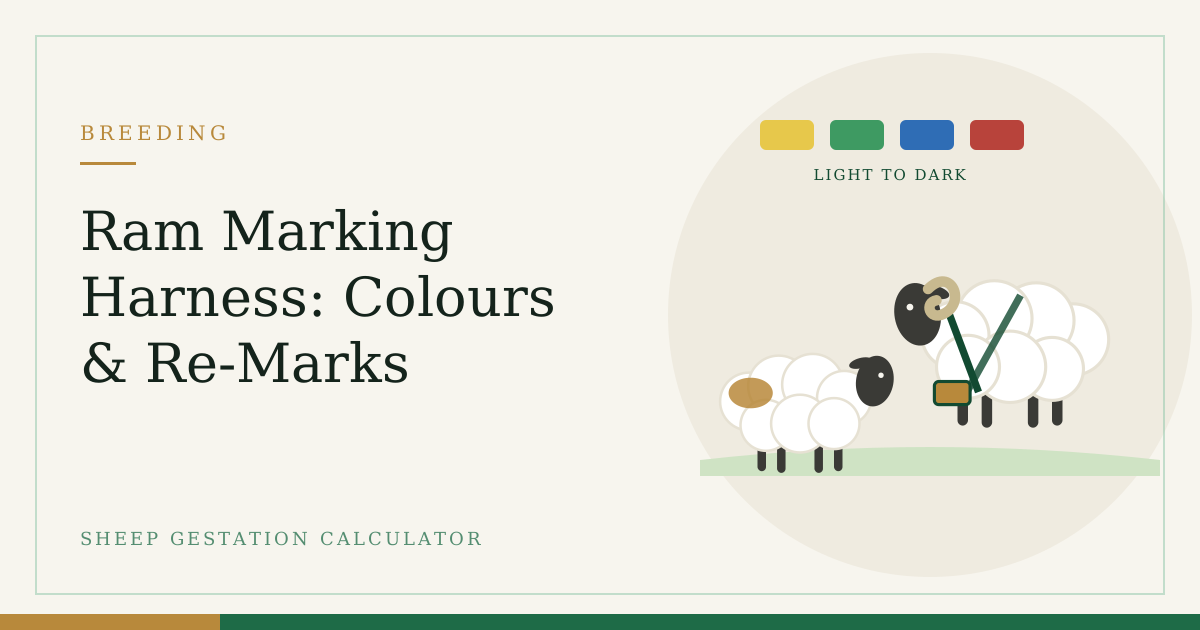
A ram fitted with a marking harness and crayon, or with raddle paste on his brisket, leaves colour on the rump of every ewe he mounts. Changing the crayon colour on a fixed schedule, typically every 16 to 17 days to match the cycle, lets you tell first services from returns. Ontario guidance suggests starting with a light colour and moving to darker ones so a later mark shows over an earlier one.
The details of fitting harnesses, choosing colours and recording marks are in the ram marking harness guide.
Teaser rams
A teaser is a ram that cannot get ewes pregnant, such as a vasectomised ram, or a specially treated wether. A teaser fitted with a harness can identify ewes in heat before artificial insemination or hand-mating, or can stimulate cycling before fertile rams go in. Any surgical preparation or hormone treatment of teasers is veterinary work.
Watching with a ram over the fence
In small flocks, some owners watch ewes near a ram kept in an adjoining pen. Ewes in heat tend to stand near the fence. It works, but it takes time at the right hours and misses shy ewes.
When returns tell you about the ram
If a large share of ewes return to heat, suspect the ram before the ewes. Teagasc advises investigating if more than about 20% of ewes are marked a second time. The decisions around when to remove rams and what to do with late ewes are covered in how long a ram should stay with ewes.
What changes the ewe’s cycle
- Season. Cycling stops during seasonal anestrus and is weakest at the edges of the season.
- Pregnancy. A pregnant ewe normally stops cycling.
- Lambing and lactation. University of Kentucky guidance notes ewes are anestrous for at least 17 to 21 days after lambing, and lactation usually suppresses heat for longer. Ontario guidance notes the first ovulation after lambing, where it happens in season, is not generally a fertile cycle.
- Age. Ewe lambs have shorter, weaker heats and more silent ovulations.
- Body condition and nutrition. Thin ewes release fewer eggs and may cycle poorly.
- Heat stress. High temperature and humidity can suppress heat behaviour.
- Illness, lameness and stress. Any significant health problem can disrupt cycling. Contact your veterinarian if several ewes that should be cycling show no activity, or if returns are widespread.
Frequently asked questions
How soon after the ram goes in will a ewe come into heat?
In the main breeding season, every cycling ewe should come into heat at some point in the first 16 to 17 days, because that is one full cycle. Where rams are introduced to ewes that have been kept away from males during the transition period, the first ovulation is usually silent and most heats appear about 17 to 25 days after ram introduction.
Can a ewe be in heat without standing for the ram?
A ewe can ovulate without showing heat, called silent ovulation, especially at the start of the season or after the ram effect. Ewe lambs are also often shy and may avoid the ram even when in heat. Standing to be mounted is the clearest sign, but its absence does not always mean she is not cycling.
How long after lambing does a ewe come back into heat?
Most ewes do not cycle for at least three weeks after lambing, and suckling lambs usually delay heat for longer. Many ewes lamb in spring and simply do not cycle again until the next autumn breeding season. Breeds with long breeding seasons may cycle sooner.
What does a second crayon mark mean?
A second mark about 16 to 17 days after the first usually means the ewe returned to heat and the first service did not hold. A mark at another interval may be a false mark or an irregular cycle. If many ewes are re-marked, check the ram’s fertility promptly.
Do ewe lambs show heat differently?
Yes. Ewe lambs usually have shorter and less intense heats, may not seek out the ram, and are more likely to ovulate silently. Many producers use experienced mature rams with ewe lambs and join them as a separate group.
Sources and further reading
- Merck Veterinary Manual: Reproductive Physiology of Sheep
- University of Kentucky Cooperative Extension: Sheep reproduction (ASC-237)
- New Mexico State University: Sheep reproduction
- Canadian Sheep Federation, Sheep Production Manual: Breeding section
- Ontario Sheep Farmers: Flock reproduction fact sheets
- Ohio State University Sheep Team: Reproductive physiology of sheep
- Teagasc: Making sure the ram is working correctly during mating
- Wheeler and Land (1977): study of seasonal breeding in Finnsheep, Tasmanian Merino and Scottish Blackface ewes, Animal Production
This article is general husbandry guidance, not veterinary advice. If ewes are failing to cycle or conceive, contact your veterinarian.
Plan your lambing dates: use the free Sheep Gestation Calculator to turn a breeding date into an expected lambing date, a 142–152 day window and a full milestone timeline. Estimates only, always consult a veterinarian for animal-health decisions.