Litter size is the number that quietly decides your year. It sets your feed bill, your shed layout, your labour requirement and, ultimately, your output. It also nudges your lambing date, ewes carrying multiples typically lamb one to two days earlier than single-bearers, a detail worth building into your plan.
The good news is that litter size is not luck. It is substantially manageable, and the levers are well understood.
What actually drives litter size
Breed and genetics
Breed is the dominant factor by a wide margin. Ovulation rate, the number of eggs released per cycle, is strongly heritable, and breeds sit along a clear spectrum.
- Low prolificacy: many hill and mountain breeds, selected for hardiness in environments where a single lamb is all a ewe can raise.
- Moderate: most terminal sire and downland breeds, Suffolk, Texel, Hampshire, typically producing singles and twins.
- High: maternal and crossbred types, Border Leicester crosses, Mules, Romney crosses, bred specifically for twinning.
- Very high: breeds carrying major prolificacy genes (the Booroola Merino and related lines being the classic example), where triplets and quads are routine.
Choosing a ram from a high-index maternal line will do more to your scanning percentage over five years than anything you do in a single autumn.
Ewe age and parity
Litter size follows a clear arc across a ewe’s life:
| Ewe age | Typical pattern |
|---|---|
| Ewe lamb (first breeding) | Mostly singles |
| Shearling / 2nd lambing | Singles and twins |
| 3-6 years | Peak, twins, more triplets |
| 7+ years | Declining, more singles |
Ewes are most prolific in their middle years. A flock full of ewe lambs and old ewes will scan poorly no matter how well you feed it, the age profile of your flock is itself a lever.
Body condition at tupping
This is the biggest thing under your direct control in any given season. Ovulation rate rises with body condition at mating, up to a point.
- Target BCS at tupping: roughly 3.0-3.5 for lowland ewes; somewhat lower for hill breeds.
- Thin ewes (BCS 2 or below) ovulate poorly, conceive late and produce fewer lambs.
- Over-fat ewes (BCS 4+) also suffer reduced fertility, and bring their own lambing problems.
Condition score in August, not October. If a ewe is thin eight weeks before the ram goes in, you have time to fix it. If she is thin the week before, you do not.
Flushing
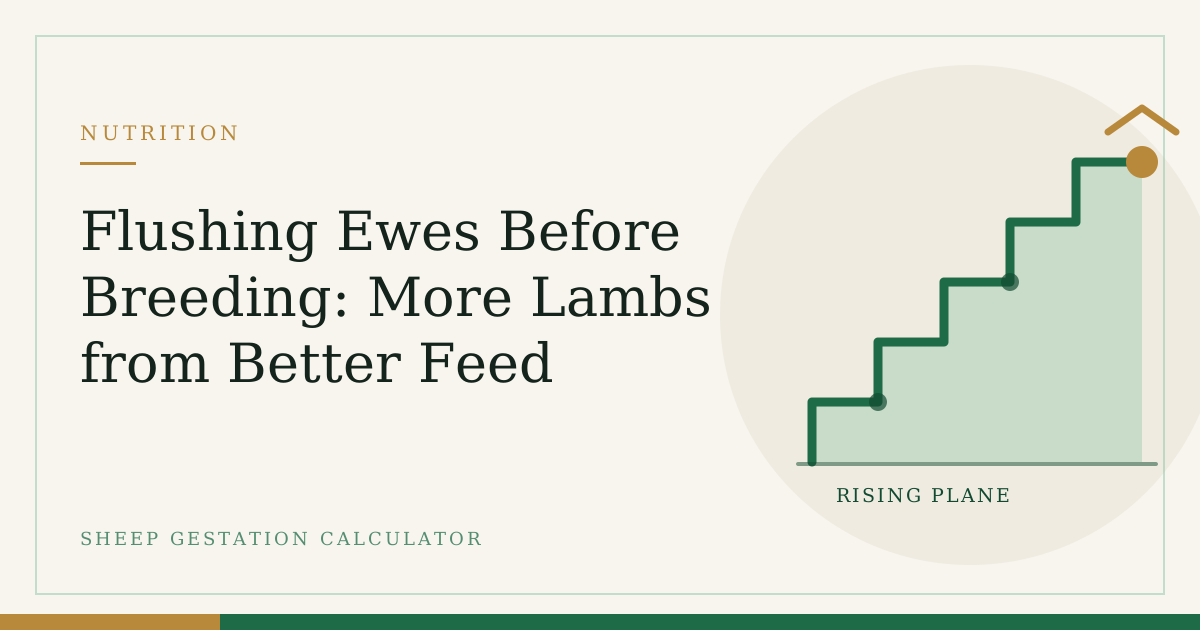
Flushing is the practice of putting ewes on a rising plane of nutrition in the weeks before and during mating, better grazing, or supplementary feed, to lift ovulation rate.
- Start roughly 3-4 weeks before the ram goes in and continue through the mating period.
- It works best on ewes in moderate condition. Flushing an already-fat ewe achieves nothing; flushing a genuinely thin ewe helps but cannot fully compensate for months of underfeeding.
- The rising trend matters as much as the absolute level.
Season and daylight
Sheep are short-day breeders. Ovulation rate tends to peak in the middle of the natural breeding season (autumn in temperate regions) and falls off at the edges. Ewes mated very early or very late in the season generally scan lower.
Ram effect and ram fertility
A fertile, sound, well-conditioned ram matters, but note that the ram’s own genetics influence litter size mainly through the daughters he leaves, not through the ewes he covers this season. His immediate job is simply to get every ewe served, promptly, in her first or second cycle.
Check rams eight weeks before tupping: feet, teeth, testicles, body condition. A lame ram serves fewer ewes, and a ram with heat-damaged semen serves them uselessly.
The consequences of a big litter
Earlier lambing
Multiples arrive earlier. The signal initiating labour comes substantially from the lambs, so a larger uterine load brings it forward, typically one to two days. Triplet-bearing ewes should be first into the shed and first on your watch list.
Lower birth weight
More lambs means smaller lambs. Triplets are commonly 25-35% lighter than a single from the same ewe. Small lambs lose heat faster, have fewer energy reserves, and are far less tolerant of a missed colostrum feed.
Colostrum arithmetic
Here is the crunch. A ewe with triplets does not produce 50% more colostrum than a ewe with twins. Colostrum yield is limited by the udder, not by the number of mouths. Three lambs competing for a twin-sized supply means at least one goes short, which is exactly why every triplet-bearing flock needs frozen or powdered colostrum on hand.
Target roughly 50ml/kg of bodyweight in the first two hours, and around 200ml/kg over 24 hours. Amounts by lamb weight and the best alternative sources are in the lamb colostrum guide.
Feed demand
Triplet-bearing ewes have the highest energy and protein requirements in the flock, and the least rumen capacity to meet them. They need the best forage, the densest concentrate, split feeds and the most trough space.
Fostering and rearing decisions
Most ewes have two teats. A ewe rearing three lambs is usually doing it badly. Plan in advance:
- Foster the third lamb onto a ewe with a single, ideally within hours of birth while both are still wet.
- Or artificially rear it, decided deliberately, with the kit ready, not improvised at 4am.
How to choose between the two, and how fostering is done, is covered in orphan lamb care: fostering vs bottle feeding.
Is more always better?
No, and this is where flocks get themselves into trouble. Every additional lamb scanned carries cost: feed, labour, mortality risk, fostering, artificial rearing. Past a certain point, chasing scanning percentage stops paying.
The number that matters is not lambs scanned. It is lambs reared per ewe put to the ram, and a flock scanning 190% with heavy triplet losses can easily be beaten by one scanning 175% that rears nearly everything it conceives.
Set your target to match your system: your shed capacity, your labour, your feed, and your tolerance for bottle lambs at midnight. Then breed and feed toward it.
Use your scan results and service dates in the Sheep Gestation Calculator to work out when the multiples are due, because they will arrive before the singles, and they will need you when they do.
This article is general husbandry guidance, not veterinary advice. For flock fertility problems or nutritional planning, consult your vet or nutritionist.
Plan your lambing dates: use the free Sheep Gestation Calculator to turn a breeding date into an expected lambing date, a 142–152 day window and a full milestone timeline. Estimates only, always consult a veterinarian for animal-health decisions.